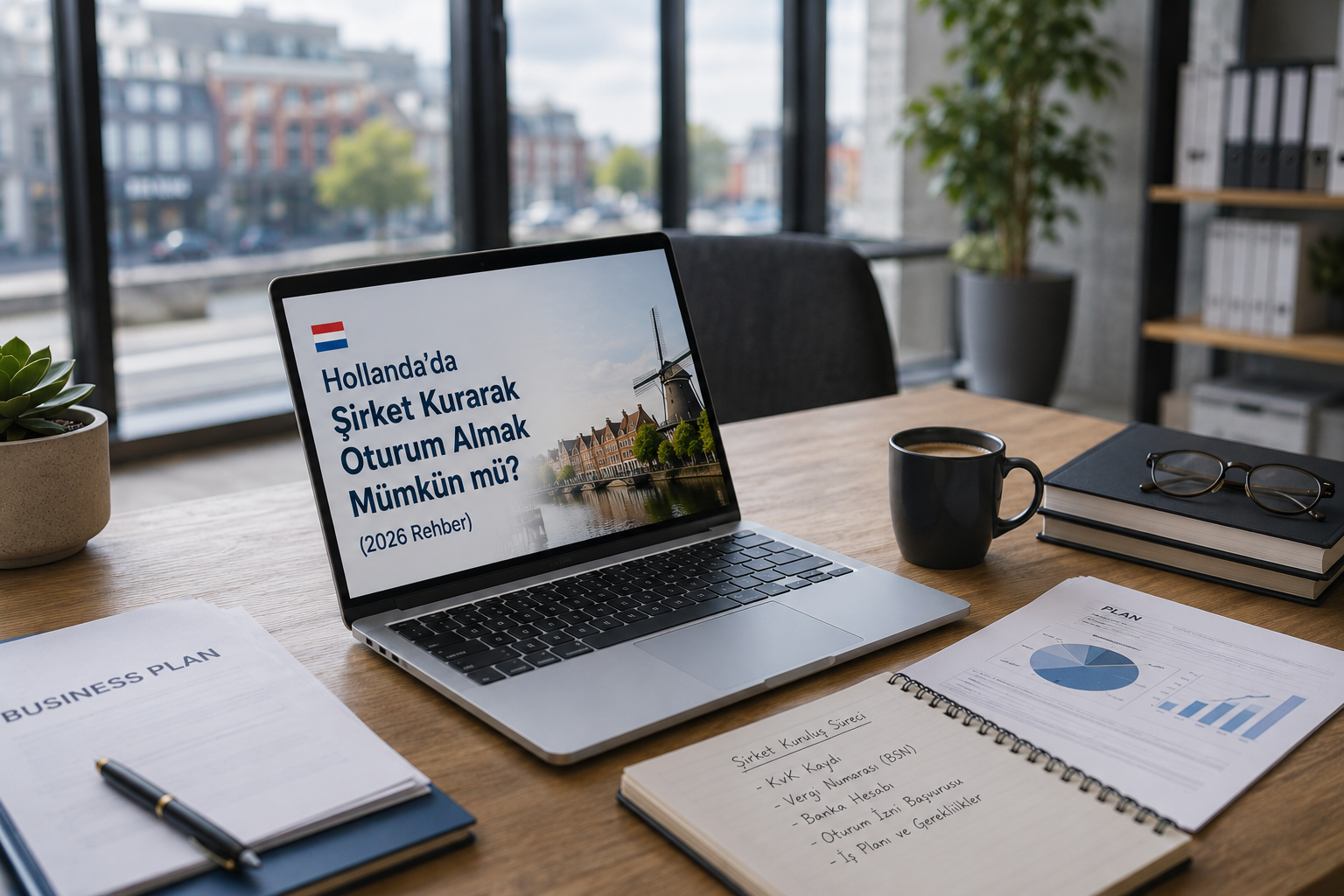
For many entrepreneurs and investors, the Netherlands is an attractive destination due to its strong economy, international trade environment, and business-friendly infrastructure. As a result, many Turkish citizens explore whether it is possible to obtain a residence permit in the Netherlands by starting a company.
While foreigners are generally allowed to establish businesses in the Netherlands, opening a company does not automatically guarantee a residence permit. Dutch immigration authorities evaluate several legal, financial, and commercial criteria before granting residence rights.
In this guide, we explain how company formation and entrepreneur residence permits work in the Netherlands, which conditions apply in 2026, and what should be considered before starting the process.
Can foreigners establish a company in the Netherlands?
Yes. Foreign nationals, including Turkish citizens, may establish companies in the Netherlands.
Common business structures include:
- Sole proprietorship
- Dutch BV (private limited company)
- Partnerships
- International trading companies
- Startup structures
The most suitable structure depends on the business model, investment goals, and immigration strategy.
Does opening a company automatically provide residence rights?
No. Registering a company alone is not enough to receive a Dutch residence permit.
The Dutch Immigration and Naturalisation Service (IND) usually evaluates:
- Economic value of the business
- Financial sustainability
- Business plan quality
- Professional background
- Market potential
- Expected income
- Contribution to the Dutch economy
A properly prepared business and immigration strategy is therefore extremely important.
Which residence permit options exist for entrepreneurs?
Depending on the situation, several immigration routes may be available.
Self-employed entrepreneur permit
For individuals planning to operate their own business activities in the Netherlands.
Startup residence permit
For innovative startups working with an approved Dutch facilitator.
Investment-related residence options
Certain investment structures may support immigration applications.
International business structures
For entrepreneurs managing existing international operations.
Each route has different legal and financial requirements.
Which documents are usually required?
The IND and Dutch authorities may request various documents.
Commonly required documents include:
- Passport
- Business plan
- Financial projections
- Proof of investment
- Chamber of Commerce registration
- Professional experience records
- Contracts or partnership agreements
- Address information
- Insurance documents
Incomplete documentation may result in delays or rejection.
Why is the business plan important?
The business plan often plays a central role in entrepreneur residence applications.
Authorities may evaluate:
- Financial feasibility
- Revenue expectations
- Market analysis
- Competitive positioning
- Investment strategy
- Long-term sustainability
- Economic contribution
A professionally prepared business plan significantly improves application quality.
How does the application process work?
The process generally involves several stages.
Business structure planning
The legal company structure and immigration strategy are determined.
Company registration
The company is officially established in the Netherlands.
IND residence application
The residence permit application is submitted to Dutch immigration authorities.
Review process
Authorities evaluate the business activity and legal eligibility.
Decision stage
A final decision is issued regarding residence rights.
How long does the process take?
The duration depends on:
- Type of residence permit
- Completeness of documents
- Complexity of the business model
- IND workload
International entrepreneur applications may take several months.
Which mistakes are most common?
Many entrepreneurs underestimate the legal and financial preparation required.
Common problems include:
- Weak business plans
- Insufficient financial documentation
- Incorrect company structures
- Poor immigration planning
- Incomplete applications
- Inadequate tax preparation
Poor preparation may lead to rejection or future legal complications.
Why professional legal guidance is important
Business immigration procedures in the Netherlands involve immigration law, tax regulations, company law, and administrative compliance. For international entrepreneurs, these systems often overlap.
Professional legal support helps with:
- Business structure planning
- IND applications
- Immigration strategy
- Legal documentation
- Tax considerations
- Risk management
- International coordination
Professionally managed applications often create more secure and sustainable business structures.
Frequently Asked Questions
Can Turkish citizens establish companies in the Netherlands?
Yes. Turkish citizens may establish businesses under Dutch commercial regulations.
Does opening a business guarantee a residence permit?
No. The business must satisfy IND immigration and economic requirements.
Which company structure is most suitable?
This depends on the business activity, investment level, and long-term goals.
How long does an entrepreneur residence application take?
The timeline varies depending on the application type and document preparation.
Is a business plan mandatory?
In most entrepreneur-based applications, yes. It is one of the most important evaluation criteria.
Conclusion
Starting a business in the Netherlands may create opportunities for entrepreneurs seeking residence rights, but company formation alone is not enough. Proper legal, financial, and immigration planning is essential for a successful application.
With professional guidance and careful preparation, entrepreneurs can reduce risks and manage Dutch business immigration procedures more securely and efficiently.